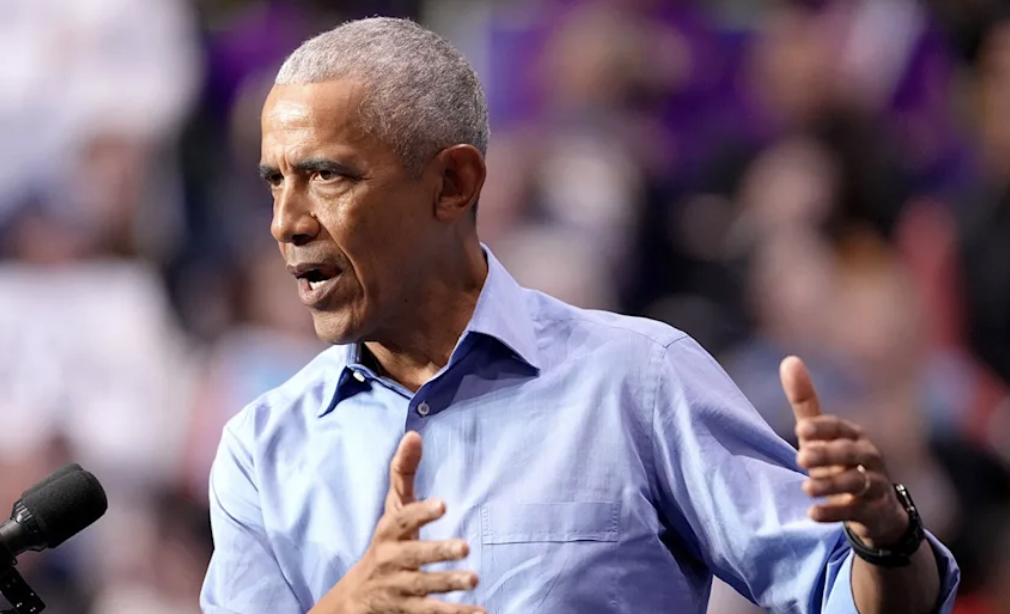
Former President Barack Obama is facing criticism from Republicans after speaking out against a recent Supreme Court decision on redistricting, with opponents pointing to what they see as a contradiction in his stance.
The Supreme Court ruled 6-3 against Louisiana’s revised congressional map, which had created a winding district that critics said relied too heavily on race. The majority called the map an unconstitutional racial gerrymander.
Obama responded by warning that the decision weakens a key part of the Voting Rights Act, arguing it could make it easier for states to dilute the political influence of minority voters as long as they frame their maps in partisan, rather than explicitly racial, terms.
His comments quickly drew pushback. Critics noted that just days earlier, Obama had supported a redistricting effort in Virginia that could significantly benefit Democrats. That plan, approved narrowly by voters in a recent referendum, would likely shift the state’s congressional delegation from a 6-5 Democratic edge to a more lopsided 10-1 split by reshaping district boundaries.
Some Republican figures seized on that contrast. Former White House press secretary Ari Fleischer mocked Obama’s position, suggesting that objections to gerrymandering seem to depend on who benefits. Others, including former congressman Mark Meadows, framed the issue more bluntly, arguing that Obama’s criticism of the Louisiana ruling undercuts his own involvement in Virginia.
Additional critics expanded the argument, pointing to other Democratic-leaning states where district maps have been accused of favoring one party. They cited examples like Illinois and several states in New England, where Republicans have struggled to gain representation despite sizable voter bases. To them, the broader issue is not just one ruling or one state, but how both parties approach redistricting when they have control.
Obama, for his part, framed the Virginia effort differently. In campaign messaging tied to the referendum, he argued that redrawing maps there was a way to counterbalance what Democrats see as Republican-led advantages in other parts of the country. He described it as an attempt to “level the playing field,” rather than tilt it.
The disagreement reflects a long-running national debate over redistricting, where legal standards, political strategy, and questions of fairness often collide. Courts have drawn a distinction between racial gerrymandering, which is unconstitutional, and partisan gerrymandering, which has been more difficult to challenge legally. That gap has allowed both parties, at different times and in different states, to pursue maps that strengthen their electoral position.
The Louisiana case underscores how complicated those distinctions can be, especially when race and party affiliation overlap. Supporters of the overturned map argue it was necessary to ensure minority representation, while opponents say it crossed constitutional lines.
As for Virginia, the newly approved map is already facing legal challenges of its own, meaning the fight over district lines there may not be settled yet. Taken together, the two situations highlight how redistricting remains one of the most contentious and unsettled areas of American politics, with no clear consensus on where to draw the line between fair representation and political advantage.