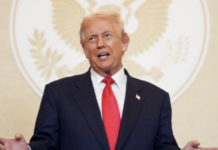
Vivek Ramaswamy says Ohio’s Medicaid system needs a major overhaul, and he’s making fraud enforcement a centerpiece of his campaign for governor.
At a press conference Tuesday in Columbus, the Republican candidate outlined a plan that would restructure how Ohio manages Medicaid data, centralize oversight across agencies, and seek federal approval to let the state keep a larger share of money recovered through anti-fraud investigations.
“We’re going to go so fast the fraudsters won’t know what hit them,” Ramaswamy said.
He said that within six months of taking office in 2027, his administration would work with lawmakers and other statewide officials to prioritize fraud enforcement. Any additional money recovered, he said, could eventually be returned to taxpayers or used to lower healthcare costs.
Ramaswamy appeared alongside several Republican leaders, including his running mate, Ohio Senate President Rob McColley. Noticeably absent were Gov. Mike DeWine and Attorney General Dave Yost, the two Republicans currently responsible for overseeing the state’s Medicaid fraud enforcement efforts. A spokesperson for DeWine said the governor was not invited, while Yost reportedly had a scheduling conflict.
The renewed focus on Medicaid fraud comes after months of criticism aimed at Ohio’s handling of the program. The Daily Wire recently published a series of reports examining possible fraud tied to home healthcare providers in Franklin County. The articles relied in part on newly available federal Medicaid spending data released through the Department of Government Efficiency initiative.
Ohio’s Medicaid program serves roughly 3 million residents and costs about $46 billion annually, with expenses shared between the state and federal governments. Fraud cases often involve providers billing Medicaid for services that were never actually delivered.
State officials have debated oversight of the program for years. Republican lawmakers have repeatedly pushed for stronger auditing requirements as Medicaid spending has grown, while DeWine has vetoed several proposals, arguing they were either unnecessary or potentially violated federal privacy protections.
Ramaswamy said Ohio currently lacks enough financial incentive to aggressively pursue fraud because the federal government covers about two-thirds of Medicaid costs. Under the current system, the state only retains a portion of recovered funds.
His proposal would ask the Trump administration’s Centers for Medicare and Medicaid Services to allow Ohio to keep more of that money. Ramaswamy said he recently discussed the idea with CMS Director Dr. Mehmet Oz and received encouraging feedback.
Tennessee previously secured federal approval for a similar arrangement that allowed it to retain part of the savings generated through Medicaid reforms.
Ramaswamy also argued Ohio’s Medicaid structure is too fragmented, with multiple agencies involved in payment processing and oversight. He wants to consolidate those systems to improve efficiency and transparency.
McColley backed that criticism, describing the Medicaid system as a “black box” that lawmakers have struggled to fully examine.
“We haven’t been able to get nearly as much information as we should be able to get,” McColley said.
Ohio Auditor Keith Faber, who also attended the event, said weak oversight has contributed to the problem. He pointed specifically to the state’s spending on home healthcare aides and questioned why Franklin County accounts for such a large share of those expenditures.
Democrats, however, accuse Republicans of using the issue selectively. They argue GOP leaders have controlled state government for years and therefore bear responsibility for any weaknesses in fraud prevention.
Some Democrats have also criticized the Daily Wire’s reporting for focusing heavily on immigrant communities while ignoring broader fraud issues elsewhere.
Ramaswamy’s Democratic opponent, former Ohio Health Director Dr. Amy Acton, dismissed the proposal as largely political theater. Her campaign said she also supports cracking down on fraud but accused Republicans of allowing waste and corruption to persist under their own leadership.
Acton recently proposed using artificial intelligence tools to identify suspicious Medicaid billing patterns, an initiative she referred to as “Buckeye AI.”
“As Governor, Dr. Amy Acton will prioritize rooting out Medicaid fraud, waste, and abuse while ensuring that Ohioans can access affordable, quality healthcare,” campaign spokeswoman Addie Bullock said in a statement.
Meanwhile, the DeWine administration maintains Ohio already has one of the nation’s stronger Medicaid fraud enforcement systems. State officials noted that some providers highlighted in recent reporting are already under investigation, and others are no longer operating.
Last week, DeWine also announced new anti-fraud measures, including restoring mandatory GPS tracking requirements for certain home healthcare aides after a previous policy change had made them optional.
For now, Medicaid fraud has quickly become one of the defining healthcare and government accountability issues heading into Ohio’s 2026 governor’s race.