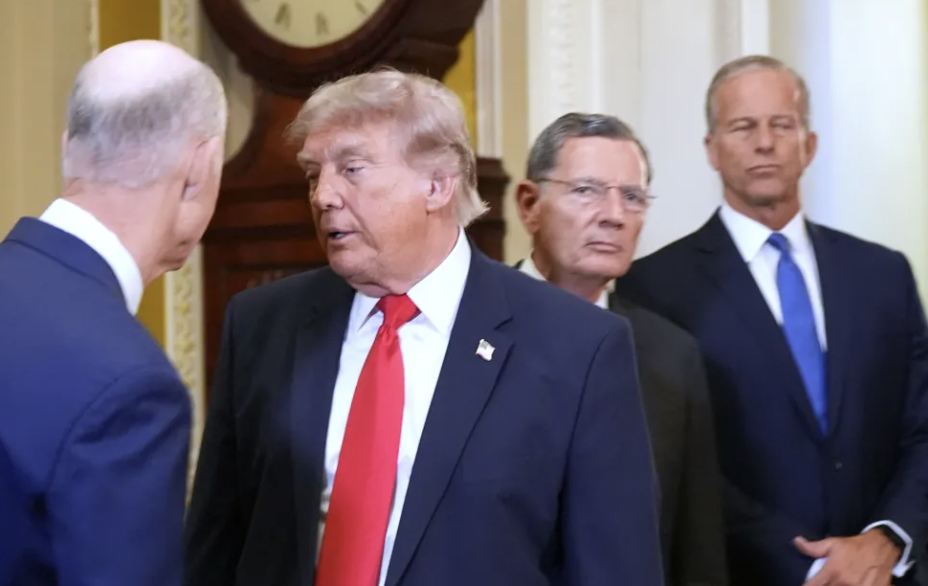
A tense exchange among Republicans on Capitol Hill appears to have ended with President Donald Trump getting the result he wanted.
On Wednesday, Trump clashed with Republican Sen. Bill Cassidy of Louisiana during a GOP luncheon, after Cassidy and three other Republican senators had supported a resolution from Democratic Sen. Tim Kaine of Virginia aimed at limiting the president’s war powers regarding Iran.
The exchange was reportedly heated. But by late Wednesday, Trump was celebrating what he described as a major shift in the Senate vote.
“Wow!” Trump wrote on Truth Social. “The Senate just changed its vote on Iran from 50-48 against, to 50-47 for. Rand Paul and Bill Cassidy changed. Thank you to Leader John Thune, Lindsey Graham, Bernie Moreno, and all. This vote puts Iran on notice!”
Kaine’s resolution would have required Trump either to seek explicit congressional authorization for military action against Iran or to “remove the United States Armed Forces from hostilities” against the country, according to Just the News.
I support President Trump’s push for diplomacy with Iran. Endless war is not a strategy. Lasting peace requires negotiation, tradeoffs, and the courage to choose diplomacy over regime change.
— Rand Paul (@RandPaul) June 25, 2026
At the Republican luncheon, Trump reportedly questioned why any Republican would support the war powers resolution.
Cassidy said he responded directly.
“I stood and said, ‘Is that a rhetorical question, or would you like to really know?’” he said.
From there, the conversation apparently turned into a shouting match between Trump and Cassidy.
The disagreement did not change the minds of Republican Sens. Susan Collins of Maine and Lisa Murkowski of Alaska. Both voted with Democrats, as they had done the day before.
But Cassidy and Republican Sen. Rand Paul of Kentucky changed course. Paul voted present, while Cassidy also withdrew his support for the resolution.
Tonight I will vote present on the War Powers resolution.
My opinion on the debate over war and executive power has not changed and I have voted that way several times.
But since hostilities seem to be over and the President asked me to give consideration to his…
— Rand Paul (@RandPaul) June 25, 2026
Paul, who has long argued that Congress should reclaim its constitutional role in matters of war, said his broader view had not changed.
“Tonight I will vote present on the War Powers resolution,” Paul wrote Wednesday night on X. “My opinion on the debate over war and executive power has not changed and I have voted that way several times.”
Paul said his decision was based on the current state of the conflict and Trump’s request for room to negotiate.
“But since hostilities seem to be over and the President asked me to give consideration to his negotiating position, I will do so,” he wrote. “My vote of present is a way to give the President more space and leverage to negotiate a lasting peace.”
On Thursday morning, Paul followed up by emphasizing diplomacy.
“I support President Trump’s push for diplomacy with Iran,” he wrote. “Endless war is not a strategy. Lasting peace requires negotiation, tradeoffs, and the courage to choose diplomacy over regime change.”
Cassidy, for his part, pointed to conversations with Vice President J.D. Vance and Special Envoy Steve Witkoff.
“I want to thank Vice President Vance and Special Envoy Witkoff for the thorough briefing this afternoon on Iran,” Cassidy wrote late Wednesday on X. “I appreciate the quick invitation to the White House to address many of my concerns.”
Tonight I will vote present on the War Powers resolution.
My opinion on the debate over war and executive power has not changed and I have voted that way several times.
But since hostilities seem to be over and the President asked me to give consideration to his…
— Rand Paul (@RandPaul) June 25, 2026
Taken together, the shift by Paul and Cassidy suggests that the White House made enough of a case to ease their concerns, at least for now. Both senators appeared to move not out of party pressure alone, but because they were persuaded that ongoing talks with Iran deserved more room.
For constitutional conservatives, the larger debate over war powers remains unresolved. Paul’s position on executive power has been consistent for years, and many on the right share his concern that presidents of both parties have stretched their authority too far.
Still, timing matters. If the administration is actively trying to bring the conflict with Iran to a close, Kaine’s resolution would have weakened Trump’s negotiating hand at a critical moment.
Democrats framed the measure as a defense of Congress’ constitutional authority. Republicans who opposed it saw something else: an attempt to undercut Trump while he was trying to secure peace.
After Wednesday’s confrontation, Trump got the votes he needed. And for the moment, Paul and Cassidy have decided that giving the president more space to negotiate is the better course.