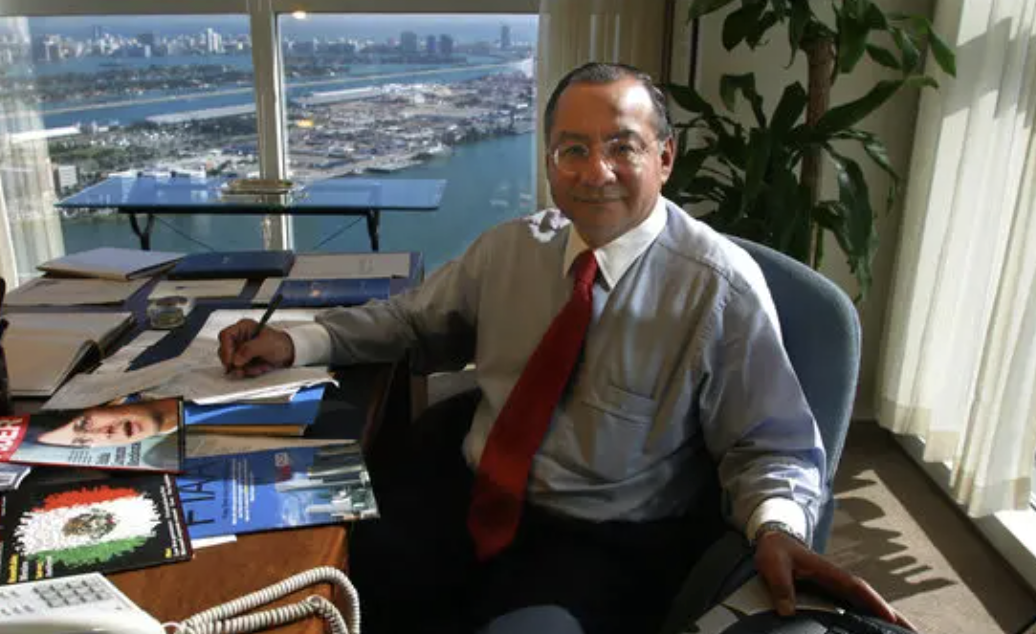
The Justice Department is moving to strip citizenship from former US diplomat Manuel Rocha, a convicted Cuban spy accused of secretly working for Havana while serving in some of the American government’s highest foreign policy roles.
Federal prosecutors filed a civil denaturalization complaint Thursday, arguing that Rocha’s decades-long cooperation with Cuba’s communist government disqualifies him from retaining US citizenship.
“Victor Manuel Rocha was not a low-level operative. He was a former United States Ambassador and senior government official who admitted he secretly served the Cuban regime for decades,” US Attorney Jason Reding Quiñones for the Southern District of Florida said in a statement announcing the move.
“This civil denaturalization case is about finishing the job,” Quiñones added. “A person who secretly serves communist Cuba should not keep the privilege of United States citizenship, even while in prison.”
Rocha, 75, was arrested in 2023 after an undercover FBI operation exposed what prosecutors described as one of the longest-running infiltrations of the US government by a foreign agent. The former ambassador later pleaded guilty and was sentenced to 15 years in federal prison.
The Justice Department has called him one of the “most prolific Cuban spies” ever uncovered in the United States.
According to court documents, Rocha spent decades quietly feeding information to Cuba while climbing the ranks of American diplomacy. He served as US ambassador to Bolivia during the George W. Bush administration and also held senior diplomatic assignments throughout Latin America, including a stint as chargé d’affaires — the top-ranking diplomat in the absence of an ambassador — in Argentina during the Clinton administration.
Investigators allege Rocha’s ties to Cuban intelligence stretched back to 1973, years before he officially became a naturalized US citizen in 1978.
Prosecutors say Rocha concealed his allegiance during the citizenship process and lied about his activities while pursuing a career inside the US government. The DOJ argues that alone provides legal grounds to revoke his citizenship.
“Rocha was not qualified for naturalization for several reasons, including that he committed unlawful acts, gave false testimony during his naturalization examination, was not attached to the principles of the U.S. Constitution and not well-disposed to the good order and happiness of the U.S.,” the department said in a statement.
Court filings and recorded conversations revealed Rocha allegedly referred to the United States as “the enemy” while speaking with an undercover FBI agent posing as a Cuban operative. Prosecutors also said Cuban intelligence handlers instructed him to “lead a normal life” and portray himself publicly as politically conservative in order to avoid suspicion.
The effort to revoke Rocha’s citizenship comes as denaturalization cases have become more common in recent years, particularly under President Trump. Although still relatively rare, the legal process has increasingly been used in cases involving alleged fraud, war crimes, terrorism, and espionage.
According to research by Hofstra University law professor Irina Manta, the first Trump administration averaged roughly 42 denaturalization cases annually — significantly higher than previous administrations. Between 1990 and 2017, the Justice Department reportedly averaged about 11 such cases per year.
Assistant Attorney General Brett Shumate said the administration views the issue as a matter of national security and the integrity of the citizenship process.
“Under no circumstances should an agent of a foreign adversary be permitted to hold the title of American citizen,” Shumate said. “Our mission is clear: to root out these fraudsters and preserve the sanctity of the naturalization process for those who adhere to our laws.”
He added that individuals who lied during the naturalization process would face “the full weight of the Department of Justice.”