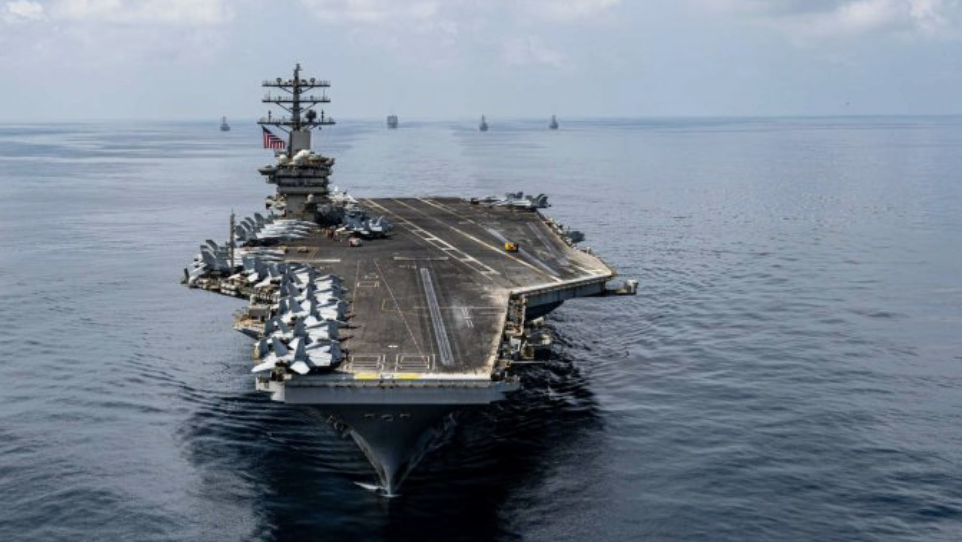
The aircraft carrier USS Nimitz and its accompanying strike group entered the southern Caribbean Sea on Wednesday in what appears to be a calculated show of force by the Trump administration as tensions with Cuba continue to escalate. While military officials insist there are no immediate plans for direct military operations, the deployment sends a clear political message to Havana and signals a growing American military presence in the region.
According to U.S. Southern Command, the Nimitz and its escort warships are expected to remain in the Caribbean for at least several days. The strike group includes advanced fighter jets, destroyers, and support vessels capable of carrying out large-scale military operations if needed. For now, however, administration officials say the deployment is intended primarily as a deterrent and demonstration of strength.
The timing of the move immediately drew attention because it came on the same day the Justice Department announced criminal charges against former Cuban leader Raúl Castro. Prosecutors accused the 94-year-old Castro and several others of conspiracy and murder connected to the 1996 shootdown of two civilian planes operated by the Miami-based humanitarian group Brothers to the Rescue. Four men were killed in the attack, including three American citizens.
Southern Command celebrated the arrival of the carrier group on social media, describing the USS Nimitz as a symbol of American military readiness and global reach. Officials emphasized the carrier’s combat history and its role in projecting U.S. power around the world.
President Donald Trump also weighed in after the announcement, telling reporters that “Cuba is on our mind,” while denying that the United States was preparing for an outright military confrontation with the island nation. Even so, the administration’s decision to send one of America’s most powerful naval assets into the Caribbean has fueled speculation about possible future actions against the Cuban government.
The Nimitz had already been operating near South America as part of a previously scheduled naval deployment. In recent weeks, the carrier participated in exercises with the Brazilian navy and other regional military partners. Still, officials and analysts noted that the decision to move the carrier into the Caribbean at this exact moment appeared far from accidental.
The deployment also comes just months after another major U.S. naval operation in the region involving the aircraft carrier USS Gerald R. Ford. That mission supported the operation that resulted in the capture of Venezuelan President Nicolás Maduro earlier this year. Much of the military force assembled for that operation later shifted to support American efforts connected to the conflict with Iran.
Despite those overlapping military commitments, the United States continues to maintain a significant naval presence in the Caribbean. The amphibious assault ship USS Iwo Jima also remains stationed in the region, underscoring Washington’s continued focus on security and political pressure campaigns in Latin America and the Caribbean.
For the Trump administration, the arrival of the Nimitz serves multiple purposes. It reinforces a hardline posture toward Cuba, reassures regional allies, and demonstrates that the United States remains capable of projecting military strength close to home even while managing conflicts elsewhere around the world.
At the same time, the deployment reflects growing tensions between Washington and Havana as the administration intensifies sanctions, legal pressure, and diplomatic demands against the Cuban government. Whether the show of force remains symbolic or evolves into something larger may depend on how relations between the two countries develop in the coming weeks.