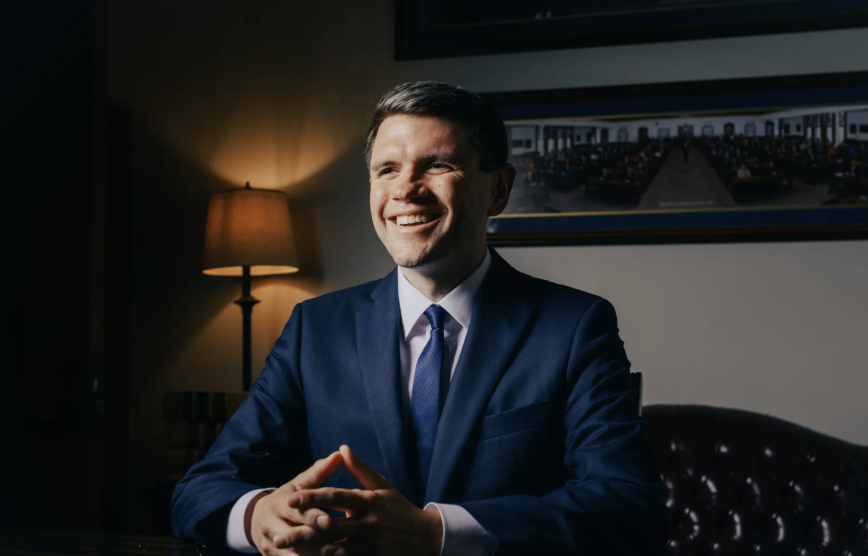
Despite presenting himself as a moderate Democrat and a “Presbyterian seminarian,” U.S. Senate candidate James Talarico is facing renewed scrutiny over past comments about Christianity and other cultural issues.
In an audio clip from 2021 that resurfaced this week, the Texas House member said, “I always think of myself as a Christian who hates Christianity, right? And, like, I always get drawn back into it.”
The comment was posted Tuesday on X by the Republican National Committee’s research arm.
“UNEARTHED,” the post said. “In an interview with a self-described ‘TransQueer’ activist theologian, Texas Democrat James Talarico says he ‘hates’ Christianity.”
MSNOW’s John Heilemann: “James Talarico is cast as a moderate. He’s not a moderate.”
“He’s pretty far to the left on a lot of issues.”
Not sure you’re supposed to be saying this stuff out loud now, John. pic.twitter.com/Gty0G6Hvy9
— Western Lensman (@WesternLensman) March 5, 2026
According to The Federalist, the audio came from an interview with Roberto Che Espinoza. Duke Divinity School’s faculty website describes Espinoza as “non-binary transqueer Latinx.”
For Texas voters, the clip may raise questions about how Talarico’s public image lines up with his past rhetoric.
It is not the first time Talarico has drawn attention for comments about faith. In 2021, he said, “God is nonbinary,” a statement he later defended in an interview with CBS News.
“Well, you know, I think, um, I was being intentionally provocative with that statement,” Talarico told the outlet. “But what it means is that God can’t be defined by human categories.”
Let me help you, @GregAbbott_TX.
Things that are child abuse:
✖️Letting children freeze to death
✖️Separating families at the border
✖️Blocking Medicaid expansionThings that are not child abuse:
✔️Gender-affirming health care https://t.co/2Ik6B0Kq4F— James Talarico (@jamestalarico) February 23, 2022
Talarico also attempted to frame the issue through scripture, referring to the Apostle Paul. Critics, however, have argued that his explanation avoids the many biblical references to “God the Father.”
When the CBS anchor pressed him further, Talarico acknowledged that some of his past comments had gone too far.
“There are some statements that I’ve made that I … that I certainly regret,” he said. “There are statements that I’ve made where I’ve missed the mark — I’ll be the first to admit that. But Ken Paxton is intentionally clipping my cringy comments to distract from his career of corruption.”
White skin gives me and every white American immunity from the virus. But we spread it wherever we go—through our words, our actions, and our systems. We don’t have to be showing symptoms—like a white hood or a Confederate flag—to be contagious.
— James Talarico (@jamestalarico) May 8, 2020
Talarico is expected to face Texas Attorney General Ken Paxton in the Senate race, but his own record is already drawing criticism from conservatives.
In 2020, Talarico described racism as a virus and suggested white Americans spread it.
“White skin gives me and every white American immunity from the virus,” he wrote on X. “But we spread it wherever we go—through our words, our actions, and our systems. We don’t have to be showing symptoms—like a white hood or a Confederate flag—to be contagious.”
🚨 UNEARTHED
In an interview with a self-described “TransQueer” activist theologian, Texas Democrat James Talarico says he “hates” Christianity:
“I always think of myself as a Christian who hates Christianity.” pic.twitter.com/wFEONx03CW
— RNC Research (@RNCResearch) June 23, 2026
In 2022, he also criticized Texas Republican Gov. Greg Abbott, saying that “gender-affirming health care” should not be treated as child abuse.
Even some media figures on the left have noted that Talarico is not exactly running from the progressive wing of his party. In March, MS NOW analyst John Heilemann said Talarico is “not a moderate” and argued that he holds “basically the same positions” as far-left Democratic Rep. Jasmine Crockett of Texas.
“He’s pretty far to the left on a lot of issues,” Heilemann said.
That contrast is likely to become a central issue in the campaign. Talarico appears eager to present himself as a thoughtful, faith-rooted moderate. His critics, however, point to his past comments as evidence that his politics and theology are much more radical than his public branding suggests.
For voters in Texas, the question is whether Talarico’s explanations are enough, or whether his own words have already defined him.