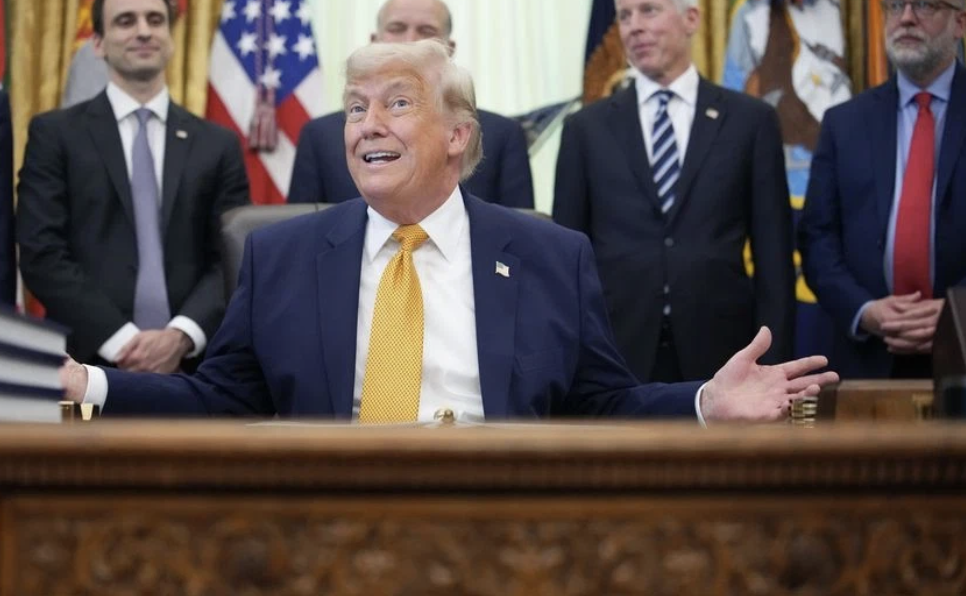
President Donald Trump says American farmers could benefit from the release of frozen Iranian assets, arguing that any funds made available to Iran would be tightly controlled and used only for humanitarian purchases from the United States.
Trump laid out the arrangement in a post on Truth Social, saying the money and sanctions relief approved by the U.S. Treasury would not be handed directly to Iran. Instead, he said, the funds would be placed in an escrow account controlled by the United States.
“The Money and/or Sanctions that the U.S. Treasury is releasing goes into escrow, controlled by the U.S.A., and will be used for the purchase of food and medical supplies, exclusively from the United States, including Corn, Wheat, and Soybeans from our great American Farmers,” Trump wrote.
He said Iran is in urgent need of those goods and described the situation as a humanitarian crisis.
“These are things that are desperately needed by Iran. This is a humanitarian crisis, and I feel it is necessary to help, NOW, before it is too late,” Trump wrote.
Trump also pushed back on media coverage of the negotiations, saying the talks with Iran are progressing better than the public is being told. He claimed Iran has agreed to sweeping nuclear inspections that would continue far into the future.
“Despite their protestations and false statements to the contrary, coupled with the drumbeat of the Fake News, which is doing everything possible to make the U.S. Victory as small and insignificant as possible, Iran has fully and completely agreed to the highest level Nuclear inspections long into the future (Infinity!!!),” Trump wrote.
He said those inspections would ensure what he called “Nuclear Honesty,” adding that negotiations would have ended if Iran had not accepted that condition.
Trump also said he agreed to keep the Strait of Hormuz open and avoid a further naval blockade because of Iran’s concessions. However, he warned that U.S. ships remain in position in case the blockade needs to be restored.
.@VP says the negotiating team accomplished a “classic Trump deal” in Switzerland.
“Where IF Iranian assets are ever unfrozen, they’re going to go to make American farmers richer, and to feed the Iranian people… that’s great for our people, great for the people of Iran, and… pic.twitter.com/C2KmCPvTob
— Rapid Response 47 (@RapidResponse47) June 22, 2026
“Talks are going well!” Trump wrote.
Vice President J.D. Vance also defended the arrangement Monday, pointing to the role of Jared Kushner, Trump’s son-in-law, and Qatari negotiators in shaping the proposal, according to CNBC.
Vance said Kushner and the Qataris helped produce “a very interesting solution” that would allow the United States to maintain control over the use of any unfrozen Iranian assets.
“What Jared and the Qataris and the entire team here in Bürgenstock accomplished is to me a classic Trump deal, where if Iranian assets are ever unfrozen, they’re going to go to make American farmers richer and to feed the Iranian people,” Vance said.
He called it good for both Americans and Iranians, and said the arrangement could support broader efforts to build stability in the region.
“That’s a very, very good and very classic Trump deal. That’s great for our people, great for the people of Iran, and fundamentally, again, will contribute to this regional security architecture that we’ve built,” Vance added.
According to Politico, Vance said the administration is trying to use the talks to reshape the Middle East over the long term. He said the goal is for the region to look “much different 10 years from now than it was 10 years ago.”
“What we’re trying to accomplish here is something very simple,” Vance said.
He described the administration’s approach as one focused on diplomacy and regional cooperation, saying officials want to move Iran away from being a source of instability and toward a role in a more peaceful regional framework.
“Through diplomacy, through working together to transform the Middle East… where Iran has been a driver of regional instability, now we see a future where everybody can work together to promote peace and prosperity for everyone,” Vance said.
He added that Trump wants to see a full regional ceasefire and said the United States is working with partners, including Qatar, Pakistan, and Israel.
“We’re all working toward regional peace,” Vance said. “There, of course, are going to be sometimes disagreements about precisely how to get there, but I actually feel great about where we are in Lebanon.”