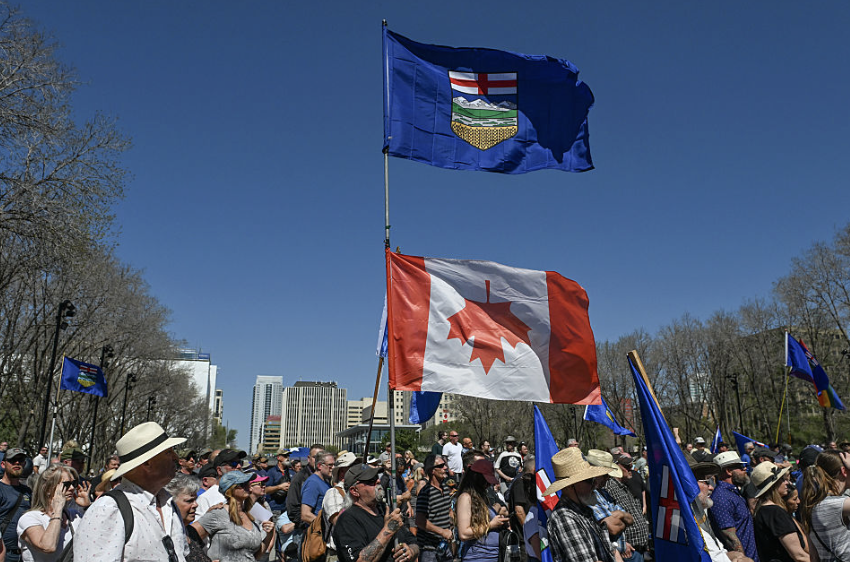
Alberta’s growing separatist movement reflects a deeper divide inside Canada that has existed for decades but has become harder to ignore in recent years. While Canada is often viewed internationally as politically unified and culturally cohesive, the reality is far more complicated.
The prairie provinces —Alberta, Saskatchewan, and Manitoba— have long seen themselves as economically productive regions whose interests are frequently overshadowed by the more populous eastern provinces of Ontario and Quebec.
That frustration is especially intense in Alberta, where oil and gas revenues have fueled both economic prosperity and political resentment. Many Albertans believe federal policies coming out of Ottawa unfairly target the province’s energy sector while redistributing wealth to provinces they see as less economically productive. Those grievances have created fertile ground for a separatist movement that, while still far from mainstream, has gained noticeable momentum.
Premier Danielle Smith’s decision to support a referendum on Alberta’s future inside Canada is significant because it gives political legitimacy to a conversation that once existed mostly on the fringes. Smith herself has made clear that she supports remaining in Canada, but she also understands that ignoring separatist sentiment entirely could further inflame tensions. Her argument is essentially that Albertans deserve the chance to voice their frustrations directly and settle the issue democratically.
Still, the path toward actual independence would be extraordinarily difficult. Even if Alberta voters approved a referendum, separation would trigger a long and politically explosive constitutional process. Canada’s federal government would first have to determine whether the referendum question and result were sufficiently clear.
After that would come years of negotiations involving borders, citizenship, Indigenous land rights, national debt, trade agreements, military arrangements, and energy infrastructure. Any final agreement would require constitutional amendments approved by Parliament and a significant number of provinces, meaning eastern Canada would effectively hold veto power over Alberta’s departure.
Because of those hurdles, many observers believe the referendum is more likely to become a political pressure tactic than a genuine step toward independence. Alberta’s government may be hoping the threat of separatism forces Ottawa to take western concerns more seriously, particularly on energy policy, environmental regulation, and federal spending priorities.
Yet the larger political implications are impossible to ignore. If Alberta seriously pursued independence, it could reignite separatist ambitions in Quebec, where the sovereignty movement has faded somewhat in recent years but never fully disappeared. Canada has already survived two Quebec independence referendums, including the razor-thin 1995 vote that nearly fractured the country. Another major province openly questioning Confederation could destabilize the national political balance in ways Ottawa would struggle to contain.
The idea of Alberta joining the United States, while often discussed jokingly, would add another layer of controversy. President Donald Trump has frequently spoken favorably about expanding American influence, and it is not difficult to imagine him publicly entertaining such an idea if Alberta voted to separate. Still, the practical and political barriers to becoming the “51st state” would be enormous on both sides of the border.
At this stage, Alberta leaving Canada remains unlikely. Most Albertans still identify strongly as Canadian, even while expressing frustration with the federal government. But the fact that a referendum is even being discussed seriously says a great deal about the growing regional divides inside Canada. What once sounded politically impossible no longer feels entirely unthinkable, and that alone represents a major shift in Canadian politics.