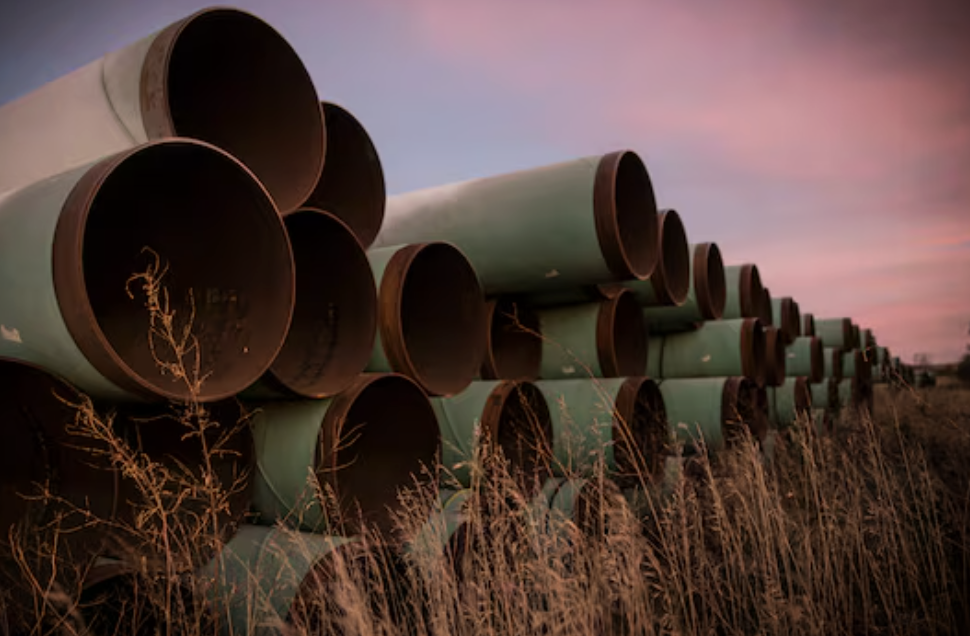
President Donald Trump suggested Tuesday that the long-debated Keystone XL pipeline could return as part of a broader trade agreement being negotiated between the United States and Canada.
Trump made the comments while announcing a temporary pause on planned 50 percent tariffs against Canada. Those tariffs had been scheduled to take effect the following morning, but Trump said they would be delayed for three days while officials worked to finalize an agreement.
“I have paused the 50% Tariffs against Canada, that were scheduled to kick in tomorrow morning for a three day period, based on the fact that Canada and the U.S.A., subject to the finalization of documents, have a DEAL!” Trump wrote on Truth Social.
He then raised the possibility that Keystone XL, one of the most politically controversial energy projects of the past two decades, could be brought back.
🇺🇸🇨🇦 The revived Keystone system and Bridger Pipeline Expansion create a major new corridor for Canadian crude into the U.S. network and existing U.S. ports.
South Bow’s Prairie Connector uses ~150 km of idle Keystone XL pipe from Hardisty, Alberta, to the Montana border. It has… https://t.co/EskLdKjbmb pic.twitter.com/HNP79gSnoE
— John Nelson (@WIgeopolitical) August 19, 2026
“The great Keystone XL Pipeline, long ago killed by Sleepy Joe Biden, may be awoken from the grave!” Trump wrote.
Trump followed the message with an AI-generated image showing himself digging the pipeline out of a grave marked with the words “Buried by Biden.”
The original Keystone XL proposal dates back to 2008. It was designed to carry crude oil from Hardisty, Alberta, to Steele City, Nebraska. From there, existing pipeline networks would transport the oil toward refineries along the Gulf Coast.
The project became a major political fight over energy development, jobs, environmental concerns and U.S.-Canada relations.
Former President Barack Obama rejected the project in 2015. Trump revived it after taking office in 2017, granting approval for construction. That effort ended again in 2021 when former President Joe Biden revoked the project’s presidential permit shortly after taking office.
Trump has made expanding North American energy infrastructure a priority since returning to the White House.
Brilliant move by President Trump. Announces a deal in place reviving the Keystine pipeline, while blaming Biden for its previous demise. Now Carney has to move ahead on it or it will look like he blew the deal. 4D chess by Trump. pic.twitter.com/XkCL6PAPkZ
— Stu St. Audré PsyD (@FreelandsQueef) August 19, 2026
On April 30, he signed an executive order authorizing a separate pipeline project that would run from Canada into the United States and ultimately toward Wyoming. That project would make use of infrastructure already constructed in Canada and follow a different route on the U.S. side than the original Keystone XL proposal.
The American portion is expected to run roughly 645 miles through Montana to Guernsey, Wyoming.
Trump highlighted the contrast between his energy policies and those of the Biden administration when signing the authorization.
“Slightly different than the last administration,” Trump said. “They wouldn’t sign a pipeline deal, and we have pipelines going up.”
Whether a full Keystone XL revival will become part of the developing U.S.-Canada trade agreement remains uncertain.
President Trump just resurrected the keystone XL pipeline from the dead that Biden cancelled 🔥🔥🔥 pic.twitter.com/9pzdJMY2Eg
— BLT (@BLT21_) August 19, 2026
Canadian Prime Minister Mark Carney said negotiations had made significant progress but acknowledged that several issues had yet to be settled.
“Substantial progress has been made, although there is important work still to be done,” Carney said.
The Office of the U.S. Trade Representative said the emerging agreement is expected to address market access for American goods, economic security, digital trade and protections for workers in both countries.
Trump’s comments nevertheless put Keystone XL back into the political conversation. A project that appeared effectively finished after Biden canceled its permit could once again become part of negotiations over trade, energy production and economic ties between the United States and Canada.