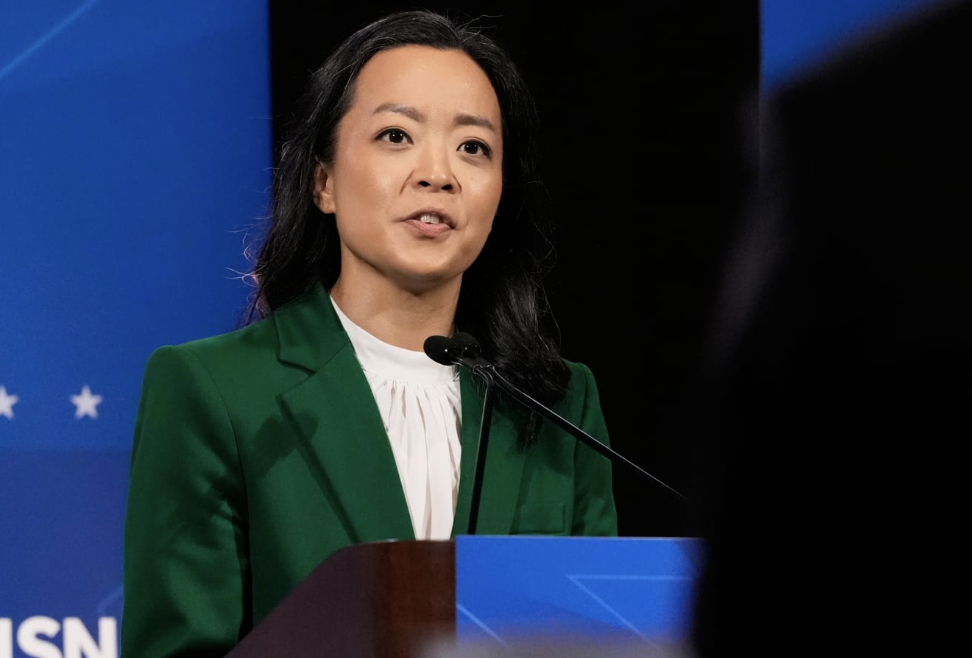
Francesca Hong, a former chef and unsuccessful restaurant owner who is now the clear favorite to win Wisconsin’s Democratic gubernatorial primary, faced an uncomfortable question Monday in a setting that is normally welcoming to Democratic candidates.
Her answer did little to help her.
Hong, who represents Madison in the Wisconsin State Assembly, entered the final stretch before the Aug. 11 primary with a sizable polling advantage. A Marquette Law School poll released July 29 showed her leading former Lt. Gov. Mandela Barnes by 22 points, 38 percent to 16 percent.
As a firmly left-wing Democrat with support from the Democratic Socialists of America, Hong had every reason to expect a relatively easy interview on CNN’s “The Source.” Instead, host Kaitlan Collins asked her about a controversial social media post she published in 2021.
“Cancel Thanksgiving,” Hong wrote at the time. “Should have done this in 1621.”
She continued by arguing that Americans should stop celebrating colonialism and describing the first Thanksgiving as an “original superspreader event” that harmed Indigenous people and women.
The post has since been deleted, but Republicans have revived it during the campaign. Collins asked Hong directly whether she still believed Thanksgiving should be canceled.
Hong appeared prepared for the question, but her response was vague and strangely indirect.
She began by recalling one of the first Thanksgiving meals she prepared as a chef. She then described the holiday as a time that can be “incredibly painful for many people in our communities.” Rather than clearly defending or rejecting her earlier statement, she said that people hold different views and that views can change over time.
She then tried to connect the controversy to her campaign.
“The position that I’m running for right now, and I think my background as a chef will actually help me become a better governor that’s able to bring more people to the table,” she said.
The line was clearly intended as a lighthearted way to move past the issue, but it came across as rehearsed. More importantly, it did not answer the question.
Hong could have said that she regretted the post. She could have defended it and explained why she still believed it. She could even have argued that her thinking had changed since 2021. Instead, she offered a collection of general statements that avoided taking a clear position.
That is the central problem. Her original post was not subtle. It did not merely call for a broader discussion about the history of Thanksgiving. It demanded that the holiday be canceled and connected its origins to colonialism, disease and the deaths of Indigenous people. A statement that direct deserves an equally direct explanation.
Collins: Do you still believe that Thanksgiving should be canceled?
Hong: I’m a chef, and one of the first meals that I made was for the community when I was 16 was a Thanksgiving meal. But Thanksgiving is also a time that’s incredibly painful for many people in our communities.… pic.twitter.com/Kd5kBZMxZS
— Acyn (@Acyn) August 4, 2026
The response also reflects a larger political challenge for Democrats. Positions that gain approval in heavily progressive communities do not always translate well to a statewide electorate, particularly in a competitive state such as Wisconsin.
Hong’s political rise is part of a broader shift within the Democratic Party. Over the past decade, progressive activists have gained greater influence over the party’s language, priorities and candidates. The election of the “Squad” in 2018 was one visible sign of that change, but the movement continued during the Biden administration and has expanded through local and state races.
Supporters see that shift as long overdue. They argue that the party is finally confronting issues involving race, immigration, gender and economic inequality with greater honesty. Critics, however, believe the party has moved too far from the concerns and values of ordinary voters.
Thanksgiving is a useful example of that divide. Many Americans recognize that the traditional story of the holiday leaves out important and painful parts of history. At the same time, most people experience Thanksgiving as a family celebration centered on gratitude, food and community. A politician who appears hostile to the holiday risks sounding hostile to the people who celebrate it.
Hong may still win the Democratic nomination. Her polling lead suggests that she is in a strong position to do so. But a general election will involve a much broader group of voters than a Democratic primary.