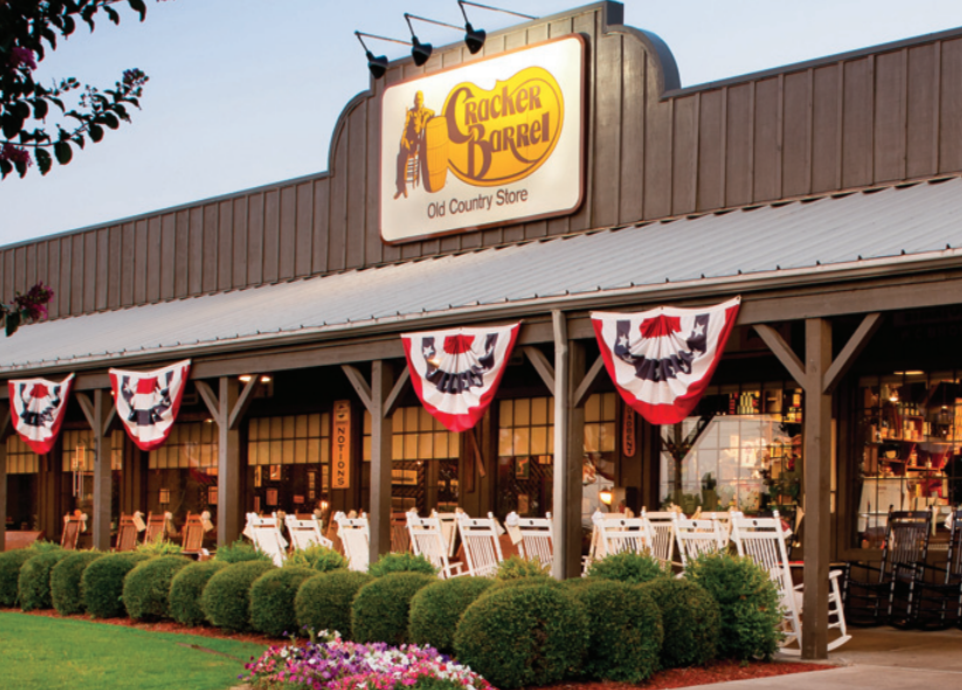
Cracker Barrel just hit the gas—straight off a cultural cliff.
The down-home, rocking-chair charm that made it a roadside staple for generations just got shoved out the back door, and in its place? A rebrand so tone-deaf, so soulless, it makes you wonder if anyone in the boardroom has ever actually been to a Cracker Barrel—or talked to someone who loves it.
The offense? A full-blown logo change. But not just any change. They scrapped the old man with a barrel—the icon, the symbol, the literal Cracker and Barrel—in favor of… whatever it is they’re calling “modern” now. Sleek, empty, sanitized. It’s as if they decided to gut the soul of the place in the name of market testing and “future resonance.” Which is corporate speak for, “We’ve forgotten who we are, but we’re hoping Gen Z buys a biscuit.”
CEO Julie Felss Masino, fresh off stints at Mattel and Taco Bell—because that screams “deep connection to Southern Americana”—told CBS her goal was to make sure the brand wasn’t stuck in the “rearview mirror.” And just like that, Cracker Barrel became the latest casualty of what happens when a heritage brand hands its identity over to a bunch of brand consultants who’ve never driven past a Waffle House.
Masino insists this isn’t about politics. That it’s just smart business. And sure, that’s easy to say when you haven’t just wiped $200 million off your company’s value in a week.
But this goes deeper than a bad logo. The rebrand is just the latest in a series of slow, creeping changes: uniforms getting more casual, alcohol creeping onto the menu (yes, really), and the old brown paper menus replaced with plastic-slick restaurant-chain clones. Even the antique décor—once lovingly collected from real estate sales to reflect authentic Americana—is being swapped out for generic reproductions that feel like they came off a Target shelf.
So much for “America’s front porch.”
And for the folks who grew up with Cracker Barrel—or worked there, like Erik Russell, who met his wife under those hanging oil lamps—it feels personal. Russell worked there nearly a decade and said it used to feel like a second home, a place where you could count on things staying grounded even as the world spun sideways. Now, he says, it feels “bland,” “soulless,” and “fake.” And he’s not wrong.
EXCLUSIVE: Cracker Barrel Insider Breaks Silence on the Woke Destruction of an American Institution
Erik Russell spent nearly 10 years working at Cracker Barrel. He’s done every job in the restaurant. Erik even met his wife there. To Erik, Cracker Barrel was a place where… pic.twitter.com/YDolLTs3dW
— Benny Johnson (@bennyjohnson) August 21, 2025
This isn’t just about aesthetics. It’s about erasing meaning. About removing the very essence of what made Cracker Barrel special in the first place. And let’s be honest: this doesn’t happen by accident.
It’s what brand strategist Andrew Beck calls the “consultant trap.” The execs bring in outsiders—like the firm Prophet, which proudly advertises its progressive values—who don’t understand the cultural DNA of the brand they’re redesigning. And instead of honoring Cracker Barrel’s roots, they impose their own worldview. A worldview that treats nostalgia like a disease and thinks “progress” means wiping the slate clean of anything traditional.
This isn’t just bad marketing. It’s cultural amnesia.
Customer’s Hate It: Cracker Barrel CEO Julie Felss Masino says people love their new rebrand. Comments on X say otherwise! She’s taken a beloved Americana Brand and trashed it with DEI Wokism. Masino promised to “identify, recruit, and advance” hires by race and now the company… pic.twitter.com/LYy6kwW3ur
— John Cremeans (@JohnCremeansX) August 21, 2025
It’s what happens when legacy brands forget that people don’t want their institutions to keep pace with every fleeting trend. They want something familiar. Something grounded. Something that feels like home. Strip that away, and what’s left? Just another overpriced chain trying to impress TikTok.
But here’s the thing: customers are noticing. They’re angry. They’re leaving. Cracker Barrel didn’t just change a logo—they sent a message. And the message was: We don’t care what this place meant to you. We’re moving on.
And yet, they act surprised by the backlash. Like it’s shocking that longtime fans—many of whom see Cracker Barrel as a symbol of simpler times, of family road trips, of Sunday mornings and country fried steak—aren’t thrilled about their beloved front porch turning into a sterile waiting room.
What Cracker Barrel forgot is that you can’t fake authenticity. You can’t slap a trendy font on a legacy and call it a brand evolution. And you definitely can’t erase the past while expecting people to trust you with the future.
So here’s a prediction: unless this gets walked back fast, Cracker Barrel isn’t heading into a bold new future.
It’s heading into a very expensive identity crisis.